O Sacrament Most Holy
An aspiration of adoration, said on arriving and as often as you like.
O Sacrament most holy, O Sacrament divine,
all praise and all thanksgiving be every moment Thine.
 Adoratio Sanctissimi Sacramenti
A holy hour before Our Lord, truly present in the Most Holy Sacrament of the Altar.
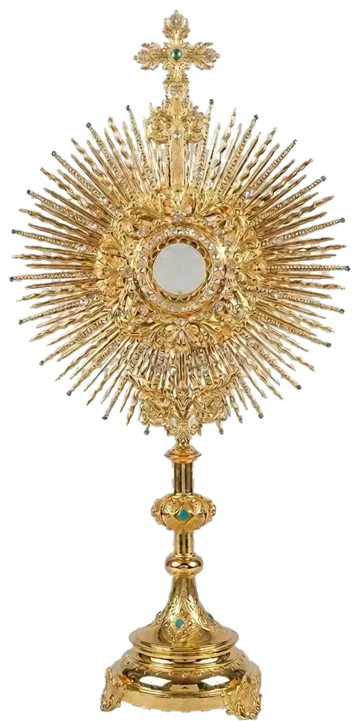
Venite, adoremusO come, let us adore Him.
If you can, close this page and go to Him.
The best place for these prayers is not a screen. It is a chapel, on your knees before the Blessed Sacrament — and better still, it is the Mass, where you may receive the One you came to adore. Everything below is meant to serve that: how to prepare, what you will see, an order for keeping the hour, the Church’s own Eucharistic prayers, and meditations to carry in with you. Print it, or bring it on a silenced phone, and let it fall away once the silence takes over.
For the days you cannot go, there is a place for you at the end of the page. To take the hour with you, there is a printable booklet.
Adoration needs no special skill. It asks only that you come, that you know Whom you have come to, and that you stay a while.
Ask at your parish when the Blessed Sacrament is exposed; many churches keep a weekly hour, and some a perpetual adoration chapel. Where He is not exposed, He is still present in the tabernacle — the burning sanctuary lamp says so — and a quiet visit there is adoration too.
Silence the phone, or leave it in the car. Dress as you would for Mass. Bring a Bible, a rosary, or this page printed — and not much else.
Take holy water and make the Sign of the Cross. Genuflect on the right knee toward the tabernacle. Before the Sacrament exposed in the monstrance, many keep the older custom of kneeling on both knees with a bow of the head; a single genuflection is also correct.
Begin on your knees if you are able, and sit when you need to; reverence matters more than posture. Begin with silence rather than words. Tell Him plainly that you are here.
If you have signed up for an hour of exposition, stay until the next adorer arrives. Our Lord exposed upon the altar is never to be left alone.
When the hour is done, genuflect again and go out quietly. Try to carry the silence with you a little way into the day.
“Could you not watch one hour with me?” Our Lord asked it of the three in Gethsemane. An hour is the traditional measure, but give what you can — thirty minutes, fifteen, or five. The order below follows the four ends of prayer: adoration, contrition, thanksgiving and supplication.
Genuflect, kneel, and simply look at Him. Make an act of faith that He is here. Let the noise of the day settle.
Make the Sign of the Cross. Pray O Sacrament Most Holy and the Angel’s prayers taught at Fatima.
Pray the Adoro Te Devote slowly, then read the first meditation. Praise Him for who He is, not for anything He has given.
Read the second meditation. Review your day, or use the Examination of Conscience, and make an Act of Contrition.
Read the third meditation. Name to Him, one by one, the gifts of the past week.
Read the fourth meditation. Bring Him the people who asked for your prayers, and those who did not. The Rosary or the Chaplet of Divine Mercy may be prayed here.
Put the page down. Read the fifth meditation if it helps, and then say nothing. This is the heart of the hour.
Read the last meditation. Pray the Tantum Ergo and the Divine Praises, and, if you have not received Holy Communion today, an Act of Spiritual Communion. Genuflect, and go in peace.
To carry into the chapel
The Holy Hour, as a booklet
Every prayer and meditation of the hour in order, with the rubrics in red, set on half-letter pages to print, fold, or keep on a phone.
The Church grants a plenary indulgence, under the usual conditions (sacramental confession, Holy Communion, prayer for the intentions of the Holy Father, and freedom from all attachment to sin), to the faithful who visit the Blessed Sacrament and adore Him for at least half an hour; a shorter visit gains a partial indulgence. (Enchiridion of Indulgences, grant 7)
The prayers and hymns the Church herself has sung before the Eucharist for centuries — most of them from the pen of St. Thomas Aquinas, who wrote the Office for the feast of Corpus Christi in 1264. The hymns are given in Latin and English.
An aspiration of adoration, said on arriving and as often as you like.
O Sacrament most holy, O Sacrament divine,
all praise and all thanksgiving be every moment Thine.
Taught by the Angel of Peace to the three shepherd children at Fatima in 1916. The apparitions at Fatima were approved by the Church in 1930.
My God, I believe, I adore, I hope, and I love You!
I beg pardon for those who do not believe, do not adore,
do not hope, and do not love You.
Most Holy Trinity, Father, Son, and Holy Spirit, I adore You profoundly.
I offer You the most precious Body, Blood, Soul, and Divinity of Jesus Christ,
present in all the tabernacles of the world,
in reparation for the outrages, sacrileges, and indifference by which He is offended.
And through the infinite merits of His Most Sacred Heart
and the Immaculate Heart of Mary,
I beg of You the conversion of poor sinners. Amen.
St. Thomas Aquinas. The English is by Gerard Manley Hopkins, and its opening stanzas are quoted by the Catechism of the Catholic Church (1381).
Adoro te devote, latens Deitas,
quae sub his figuris vere latitas:
tibi se cor meum totum subiicit,
quia te contemplans totum deficit.
Visus, tactus, gustus in te fallitur,
sed auditu solo tuto creditur;
credo quidquid dixit Dei Filius:
nil hoc verbo Veritatis verius.
In cruce latebat sola Deitas,
at hic latet simul et humanitas;
ambo tamen credens atque confitens,
peto quod petivit latro paenitens.
Plagas, sicut Thomas, non intueor;
Deum tamen meum te confiteor;
fac me tibi semper magis credere,
in te spem habere, te diligere.
O memoriale mortis Domini!
Panis vivus, vitam praestans homini!
Praesta meae menti de te vivere,
et te illi semper dulce sapere.
Pie pellicane, Iesu Domine,
me immundum munda tuo sanguine,
cuius una stilla salvum facere
totum mundum quit ab omni scelere.
Iesu, quem velatum nunc aspicio,
oro fiat illud quod tam sitio;
ut te revelata cernens facie,
visu sim beatus tuae gloriae. Amen.
Godhead here in hiding, whom I do adore,
Masked by these bare shadows, shape and nothing more,
See, Lord, at thy service low lies here a heart
Lost, all lost in wonder at the God thou art.
Seeing, touching, tasting are in thee deceived;
How says trusty hearing? that shall be believed;
What God’s Son has told me, take for truth I do;
Truth himself speaks truly or there’s nothing true.
On the cross thy godhead made no sign to men,
Here thy very manhood steals from human ken:
Both are my confession, both are my belief,
And I pray the prayer of the dying thief.
I am not like Thomas, wounds I cannot see,
But can plainly call thee Lord and God as he;
Let me to a deeper faith daily nearer move,
Daily make me harder hope and dearer love.
O thou our reminder of Christ crucified,
Living Bread, the life of us for whom he died,
Lend this life to me then: feed and feast my mind,
There be thou the sweetness man was meant to find.
Bring the tender tale true of the Pelican;
Bathe me, Jesu Lord, in what thy bosom ran—
Blood whereof a single drop has power to win
All the world forgiveness of its world of sin.
Jesu, whom I look at shrouded here below,
I beseech thee send me what I thirst for so,
Some day to gaze on thee face to face in light
And be blest for ever with thy glory’s sight. Amen.
Sung at the beginning of exposition. The closing stanzas of St. Thomas Aquinas’s hymn Verbum Supernum Prodiens; English by Edward Caswall.
O salutaris Hostia,
quae caeli pandis ostium:
bella premunt hostilia,
da robur, fer auxilium.
Uni trinoque Domino
sit sempiterna gloria,
qui vitam sine termino
nobis donet in patria. Amen.
O saving Victim, opening wide
The gate of heaven to man below!
Our foes press on from every side;
Thine aid supply, Thy strength bestow.
To Thy great name be endless praise,
Immortal Godhead, One in Three;
O grant us endless length of days
In our true native land with Thee. Amen.
Sung before Benediction. The last two stanzas of St. Thomas Aquinas’s Pange Lingua; English by Edward Caswall. The versicle and the collect of Corpus Christi follow.
Tantum ergo Sacramentum
veneremur cernui:
et antiquum documentum
novo cedat ritui:
praestet fides supplementum
sensuum defectui.
Genitori, Genitoque
laus et iubilatio,
salus, honor, virtus quoque
sit et benedictio:
procedenti ab utroque
compar sit laudatio. Amen.
V. Panem de caelo praestitisti eis.
R. Omne delectamentum in se habentem.
Oremus. Deus, qui nobis sub sacramento mirabili passionis tuae memoriam reliquisti: tribue, quaesumus, ita nos corporis et sanguinis tui sacra mysteria venerari, ut redemptionis tuae fructum in nobis iugiter sentiamus. Qui vivis et regnas in saecula saeculorum.
R. Amen.
Down in adoration falling,
Lo! the sacred Host we hail;
Lo! o’er ancient forms departing,
Newer rites of grace prevail;
Faith for all defects supplying,
Where the feeble senses fail.
To the everlasting Father,
And the Son who reigns on high,
With the Holy Ghost proceeding
Forth from Each eternally,
Be salvation, honour, blessing,
Might and endless majesty. Amen.
V. You have given them bread from heaven.
R. Having all sweetness within it.
Let us pray. O God, who in this wonderful Sacrament have left us a memorial of your Passion, grant us, we pray, so to revere the sacred mysteries of your Body and Blood that we may always experience in ourselves the fruits of your redemption. Who live and reign for ever and ever.
R. Amen.
Said after Benediction, in reparation for blasphemy. Composed by Fr. Luigi Felici, S.J., in 1797, and enlarged by later popes.
Blessed be God.
Blessed be His Holy Name.
Blessed be Jesus Christ, true God and true Man.
Blessed be the Name of Jesus.
Blessed be His Most Sacred Heart.
Blessed be His Most Precious Blood.
Blessed be Jesus in the Most Holy Sacrament of the Altar.
Blessed be the Holy Spirit, the Paraclete.
Blessed be the great Mother of God, Mary most holy.
Blessed be her holy and Immaculate Conception.
Blessed be her glorious Assumption.
Blessed be the name of Mary, Virgin and Mother.
Blessed be Saint Joseph, her most chaste spouse.
Blessed be God in His Angels and in His Saints.
“I look at him and he looks at me.”
A peasant of Ars, praying before the tabernacle · CCC 2715Six short meditations, one for each part of the hour. Each begins with the Word of God, sets beside it the teaching of the Church, and ends in a question to take into the silence. Read slowly; stop wherever a line holds you.
The First Meditation · Adoration
Thomas answered and said to him: My Lord and my God.
John 20:28Be still and see that I am God; I will be exalted among the nations, and I will be exalted in the earth.
Psalm 45:11
What rests in the monstrance looks like a small circle of bread. The eyes report bread, and the eyes are wrong. St. Thomas put it in a single line of his hymn: seeing, touching and tasting are deceived here, and only hearing is safe — hearing the word of the One who said, This is my body.
Adoration begins there: not with anything we feel, but with the plain confession of the Apostle who had doubted. Thomas saw wounds and confessed God. We see a Host and confess the same God, the same wounds, the same risen flesh.
“In the most blessed sacrament of the Eucharist ‘the body and blood, together with the soul and divinity, of our Lord Jesus Christ and, therefore, the whole Christ is truly, really, and substantially contained.’” Catechism of the Catholic Church, 1374
In the silenceSay to Him, without hurry, “My Lord and my God,” and mean each word separately.
The Second Meditation · Contrition
And the publican, standing afar off, would not so much as lift up his eyes towards heaven; but struck his breast, saying: O God, be merciful to me a sinner.
Luke 18:13Create a clean heart in me, O God: and renew a right spirit within my bowels.
Psalm 50:12
Close to so great a holiness, a man sees himself more clearly. That is not a reason to stay away; it is the reason He stays. The publican stood at the back of the Temple and went home justified. Our Lord did not come down upon the altar for those who think themselves well, but for the sick.
Let the light of the Host fall over the day and the week behind you. Name what you find. Do not argue with it or excuse it; hand it over. If something grave is there, resolve now on the day you will bring it to confession.
A sacrifice to God is an afflicted spirit: a contrite and humbled heart, O God, thou wilt not despise.
Psalm 50:19
In the silenceWhat would I most like Him not to see? Show Him that first.
The Third Meditation · Thanksgiving
What shall I render to the Lord, for all the things that he hath rendered to me? I will take the chalice of salvation; and I will call upon the name of the Lord.
Psalm 115:12–13And whilst they were at supper, Jesus took bread and blessed and broke and gave to his disciples and said: Take ye and eat. This is my body.
Matthew 26:26
The word Eucharist means thanksgiving. On the night He was betrayed, with the Cross a day away, Our Lord gave thanks — and then gave Himself, so that He would never have to leave us. Every tabernacle in the world is the answer to the fear of the Apostles that night: that He was going away.
The Psalmist could find only one fitting return for all God had given him: to take the chalice of salvation. We have nothing to give Him that He has not first given us, and He asks for nothing but that we receive Him.
“In his Eucharistic presence he remains mysteriously in our midst as the one who loved us and gave himself up for us, and he remains under signs that express and communicate this love.” Catechism of the Catholic Church, 1380
In the silenceThank Him for three particular things from this week, and for one thing you had not thought to thank Him for.
The Fourth Meditation · Supplication
Come to me all you that labor and are burdened, and I will refresh you. Take up my yoke upon you, and learn of me, because I am meek, and humble of heart: And you shall find rest to your souls.
Matthew 11:28–29All that the Father giveth to me shall come to me: and him that cometh to me, I will not cast out.
John 6:37
It is no presumption to ask. The same Lord who sits enthroned in the monstrance once stopped in a crowd for a woman who touched His hem, and turned in the road for two blind men shouting after Him. Here He is just as near, and just as willing to be interrupted.
Bring Him your own needs, plainly. Then bring Him the others: your family, the sick, the dying, the dead, the priest who offered the Mass at which this Host was consecrated, and those who have no one to pray for them. Intercession before the Blessed Sacrament is the Church at prayer for the whole world.
And behold I am with you all days, even to the consummation of the world.
Matthew 28:20
In the silenceWho has no one praying for them today? Put them before Him by name.
The Fifth Meditation · Abiding
Abide in me: and I in you. As the branch cannot bear fruit of itself, unless it abide in the vine, so neither can you, unless you abide in me.
John 15:4One thing I have asked of the Lord, this will I seek after; that I may dwell in the house of the Lord all the days of my life. That I may see the delight of the Lord, and may visit his temple.
Psalm 26:4
There comes a point in the hour when words run out. That is not failure; it is arrival. The peasant of Ars, asked what he said to Our Lord all those hours before the tabernacle, answered that he said nothing: he looked at Him, and Our Lord looked at him.
Let the page go. If your mind wanders, return to His Name, or to a single line of Scripture, and look again. You have come to be with Him, not to accomplish anything.
“Contemplation is a gaze of faith, fixed on Jesus. … His gaze purifies our heart; the light of the countenance of Jesus illumines the eyes of our heart and teaches us to see everything in the light of his truth and his compassion for all men.” Catechism of the Catholic Church, 2715
In the silenceLook at Him. Let Him look at you.
The Last Meditation · Going Forth
But they constrained him, saying: Stay with us, because it is towards evening and the day is now far spent. And he went in with them. And it came to pass, whilst he was at table with them, he took bread and blessed and brake and gave to them. And their eyes were opened: and they knew him.
Luke 24:29–31And they told what things were done in the way: and how they knew him in the breaking of bread.
Luke 24:35
The two disciples walked seven miles beside Him without knowing Him, and knew Him at once in the breaking of the bread. Then they rose that same hour and went back to Jerusalem in the dark to tell the others.
The hour of adoration ends the same way. You do not leave Him behind in the chapel; you carry what you have seen back into the road. And the hour points onward, to the altar where the bread is broken again and He gives Himself to be received.
In the silenceAsk Him to stay with you through the evening of this day — and tell Him when you will next come to Mass.
Adoration is not a substitute for the Mass. It flows out of the Mass, and it leads back to it. The Host in the monstrance was consecrated at an altar, so that He might be received.
“Eucharistic adoration is simply the natural consequence of the eucharistic celebration, which is itself the Church’s supreme act of adoration.” Pope Benedict XVI, Sacramentum Caritatis, 66
St. Augustine put the two together long before: “No one eats that flesh without first adoring it; we should sin were we not to adore it.” We adore Him because we receive Him, and we receive Him better for having adored. If there is a weekday Mass near the chapel where you keep your hour, there is no better way to begin or to end it. For the Mass itself, see The Mass; for the Sacrament, The Sacraments.
The words of the Roman Missal, said by the faithful before Communion, after the centurion of Capernaum (Matthew 8:8).
Domine, non sum dignus,
ut intres sub tectum meum:
sed tantum dic verbo,
et sanabitur anima mea.
Lord, I am not worthy
that you should enter under my roof,
but only say the word
and my soul shall be healed.
After receiving. A prayer of the fourteenth century, much loved by St. Ignatius of Loyola, who set it at the head of his Spiritual Exercises.
Anima Christi, sanctifica me.
Corpus Christi, salva me.
Sanguis Christi, inebria me.
Aqua lateris Christi, lava me.
Passio Christi, conforta me.
O bone Iesu, exaudi me.
Intra tua vulnera absconde me.
Ne permittas me separari a te.
Ab hoste maligno defende me.
In hora mortis meae voca me.
Et iube me venire ad te,
ut cum Sanctis tuis laudem te
in saecula saeculorum. Amen.
Soul of Christ, sanctify me.
Body of Christ, save me.
Blood of Christ, inebriate me.
Water from the side of Christ, wash me.
Passion of Christ, strengthen me.
O good Jesus, hear me.
Within Thy wounds hide me.
Suffer me not to be separated from Thee.
From the malicious enemy defend me.
In the hour of my death call me.
And bid me come to Thee,
That with Thy saints I may praise Thee
Forever and ever. Amen.
Illness, distance, work, the care of children or of the old: there are days when the chapel is out of reach, and days when one cannot receive. Our Lord is not out of reach on those days.
Turn, if you can, toward the nearest church, where He is present in the tabernacle. Make the Sign of the Cross, pray the prayers on this page as if you were kneeling there, and keep a few minutes of silence. Then make an act of spiritual communion — the desire to receive Him, offered to Him when you cannot receive Him sacramentally. It is the prayer of the saints in prison, at sea, and on the sickbed, and it is yours too.
In the tradition of St. Alphonsus Liguori, Doctor of the Church, whose Visits to the Blessed Sacrament taught generations to make one daily.
My Jesus, I believe that You are present in the Most Holy Sacrament.
I love You above all things, and I desire to receive You into my soul.
Since I cannot at this moment receive You sacramentally,
come at least spiritually into my heart.
I embrace You as if You were already there
and unite myself wholly to You.
Never permit me to be separated from You. Amen.
“Jesus awaits us in this sacrament of love. Let us not refuse the time to go to meet him in adoration, in contemplation full of faith, and open to making amends for the serious offenses and crimes of the world. Let our adoration never cease.” Pope St. John Paul II, quoted in the Catechism of the Catholic Church, 1380
Collected for the faithful of The Layman’s Lantern
Scripture from the Douay-Rheims Bible. Teaching from the Catechism of the Catholic Church, the Code of Canon Law, the Enchiridion of Indulgences, and Pope Benedict XVI’s Sacramentum Caritatis. Hymns of St. Thomas Aquinas, in the translations of Gerard Manley Hopkins and Edward Caswall.